Fully funded M.A. and Ph.D. programs in French and in Italian. Applications are open for admission in Fall 2027. We review applications on a rolling basis, with a December 15, 2026 priority deadline.
Key dates for Fall 2027
| Application received | What it means |
|---|---|
| By December 15, 2026 | Full consideration for the University’s largest competitive fellowships (strongly encouraged) |
| December 16, 2026 – January 15, 2027 | Considered in a second, more limited fellowship round |
| After January 15, 2027 | Full consideration for admission; not eligible for additional recruitment fellowships |
Priority research profiles for 2027–2028
We accept applications in all research fields in French Studies and Italian Studies. This year, we have priority interest in four research profiles.
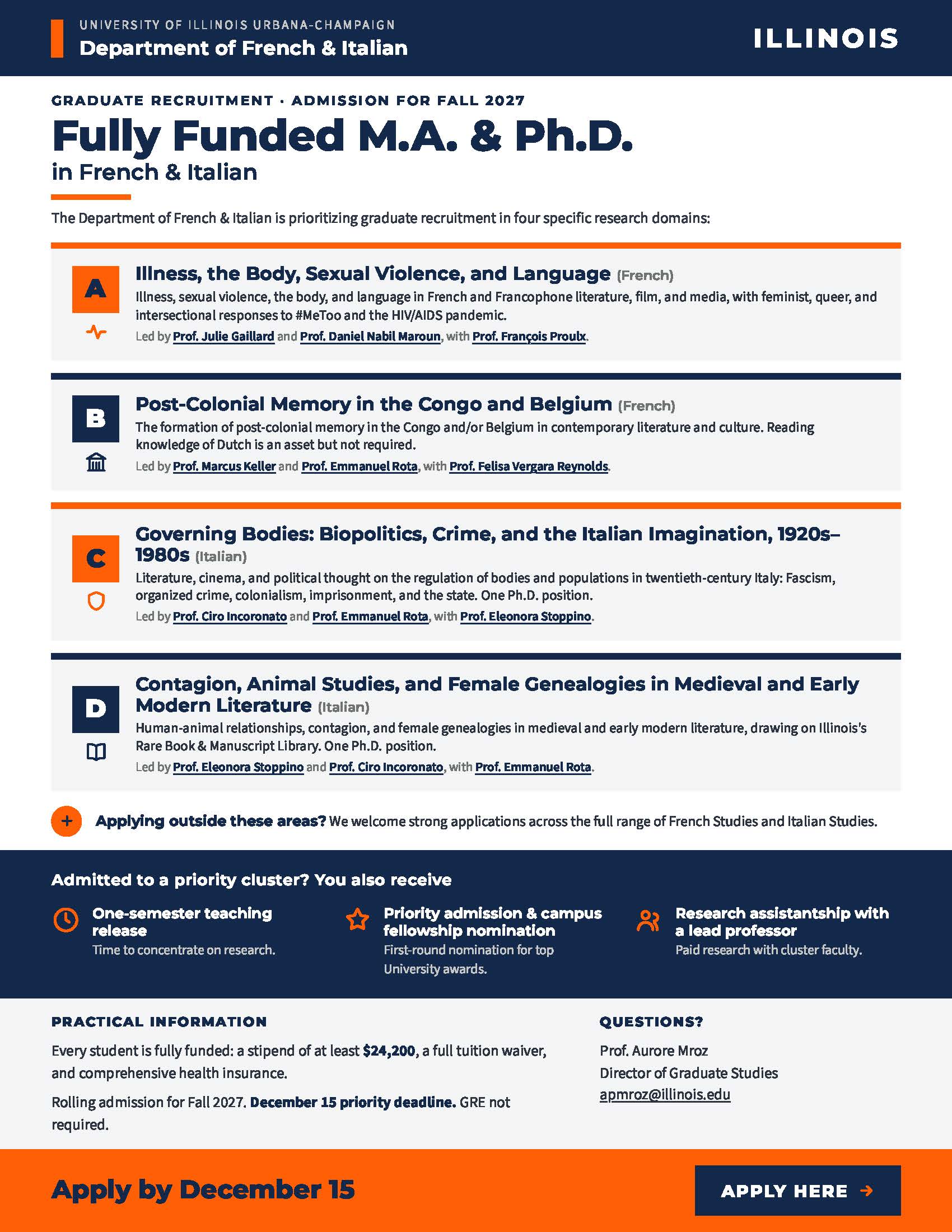
A. Illness, sexual violence, the body, and language (French)
1 M.A. or Ph.D. position · Led by Prof. Gaillard and Prof. Maroun, in collaboration with Prof. Proulx.
This cluster studies representations and intersections of illness, sexual violence, the body, and language in contemporary French and Francophone literature, film, and other media, including feminist, queer, and intersectional responses to the #MeToo movement and the HIV/AIDS pandemic. The corpus is open to the wider French-speaking world, and analyses can move across literature and cinema, law, testimony, public discourse, and government policy.
B. Post-colonial memory in the Congo and Belgium (French)
1 M.A. or Ph.D. position · Led by Prof. Keller and Prof. Rota, in collaboration with Prof. Vergara Reynolds.
This cluster examines the formation of post-colonial memory in the Congo and Belgium as a significant case of the interconnected history of Africa and Europe and their shared colonial and post-colonial experience. Projects may explore how colonialism and decolonization shape memory in the Congo, Belgium, and beyond; how Congolese diasporic perspectives challenge European narratives of modernity and progress; or how colonial legacies inform contemporary Belgian, Congolese, European, and African identities. Interdisciplinary and/or comparative approaches and a varied corpus of literary and cultural production in French are encouraged. Reading knowledge of Dutch is an asset but not required.
C. Governing Bodies: Biopolitics, Crime, and the Italian Imagination, 1920s–1980s (Italian)
1 Ph.D. position · Led by Prof. Incoronato and Prof. Rota, in collaboration with Prof. Stoppino.
This cluster explores how literature, cinema, and political thought have represented and challenged the regulation of bodies and populations in twentieth-century Italy. Themes include Fascism, organized crime, colonialism, racial politics, imprisonment, workers’ movements, and the relationship between state authority and everyday life, as well as how earlier Italian ideas about contagion, lineage, and bodily difference shaped modern debates. We particularly welcome comparative and transnational approaches to migration, diasporas, cross-border networks, and the international circulation of cultural and political ideas. Applicants may work across periods, media, and disciplines; no prior expertise in every aspect of the project is expected.
D. Contagion, Animal Studies, and Female Genealogies in Medieval and Early Modern Literature (Italian)
1 Ph.D. position · Led by Prof. Stoppino and Prof. Incoronato, in collaboration with Prof. Rota.
This cluster explores how literary texts represent relationships between humans and animals, the transmission of disease and behavior, and women’s roles in narratives of descent, inheritance, and political authority. Possible projects include women warriors in epic and romance; maternal lineages and dynastic narratives; animals and education; and connections between bodily difference, gender, and belonging. We welcome interdisciplinary, comparative, and transnational approaches, including the circulation of texts and ideas across languages, Mediterranean encounters, and connections between Italian literature and other cultural traditions. Students will have access to Illinois’s Rare Book & Manuscript Library, whose medieval and Renaissance manuscripts, early printed books, and extensive Italian holdings (including the Cavagna Sangiuliani Collection) open opportunities in book history and the study of material texts.
Applying to a research profile
Applicants are invited to propose their own projects within these broad themes. Ph.D. applicants should hold a master’s degree or equivalent in French Studies, Italian Studies, comparative literature, medieval studies, history, philosophy, gender studies, cinema studies, or a related field. To be considered for a profile, name it in your academic statement of purpose (by letter and title) and explain in detail your qualifications and how you would make the project your own.
Applicants admitted to one of these profiles receive:
- priority consideration in admission and first-round nomination for the University’s most competitive recruitment fellowships;
- guaranteed summer funding for each of the first two summers (research, language study, or archival work);
- a one-course teaching release during preliminary examinations;
- the opportunity to work as a Research Assistant with a cluster professor;
- three faculty mentors from day one: two lead faculty and a collaborator who know your project and read your work.
What we fund
Every admitted graduate student, domestic or international, receives guaranteed support for 4 to 6 years, including:
- a teaching assistantship or fellowship with a stipend of at least $24,200;
- a full tuition waiver, partial fee waiver, and comprehensive health insurance;
- up to $2,000 toward the cost of arriving.
Additional funding is awarded competitively for summer support, conference travel, course releases, and dissertation completion. We help students build competitive applications: last year, our incoming and continuing students held three recruitment fellowships worth up to $75,000 each and two Dissertation Completion Fellowships of $25,000 each.
Beyond these profiles
The profiles are an invitation, not a restriction. We continue to welcome strong applications across French Studies and Italian Studies: global and transnational literatures and cultures from the early modern period to the present, across the French-speaking Americas, North and West Africa, the Mediterranean, and continental Europe, with strengths in postcolonial studies, migration and minority studies, gender and queer studies, critical theory, film and visual studies, and digital humanities. If your project sits close to a profile without matching it exactly, we would very much like to hear from you.
French Applied Linguistics, French SLATE, and French Linguistics: across the M.A. in French Applied Linguistics and the Ph.D. tracks in French SLATE and French Linguistics, we anticipate admitting at most one student this cycle; that place may carry a one-year deferral to Fall 2028.
Why Illinois
Close mentoring. Ours is a small department: you will know your faculty, and they will know your project. Students admitted to a research profile work from the start with three faculty, so their writing is read by more than one person. Students outside a profile build the same kind of team during their first year, choosing the faculty whose work speaks to theirs. Every graduate student also meets regularly with the Director of Graduate Studies.
Teaching preparation. Graduate students teach up to three courses a year, from beginning language through advanced content, and design and assess their own courses, supported by research-based pedagogical training from faculty who study how languages are learned and taught. Our instructors appear regularly on the campus-wide List of Teachers Ranked as Excellent by Their Students, and they reach the job market with teaching portfolios comparable to those of early-career assistant professors. A teaching release may be available during or after preliminary examinations.
Placement. Over the past fifteen years, all of our doctoral graduates who sought employment found it, on three continents: Princeton, Brown, Boston University, Ohio State, the University of Chicago, Université de Strasbourg, University College London, the University of Melbourne, and Australian National University, as well as Deliveroo, Trimble, Immerse, and The Immigration Project. Illinois is one of only two programs in the country with multiple winners of ACTFL’s Emma Marie Birkmaier Award for doctoral research. By graduation, our students have typically published, presented at international conferences, and built strong research and teaching portfolios.
Campus and community. Illinois enrolls more than 60,000 students and holds the largest public university library in the country. Urbana-Champaign is a college town 150 miles south of Chicago, with free public transportation and a cost of living far below that of most peer programs’ cities. Urbana is a designated sanctuary city; our Graduate Student Organization (GSFRIT) runs its own reading and social life; and the department is family-friendly in practice as well as in policy. Graduate students with families, students with disabilities, first-generation students, and international students are a central part of who we are.
How to apply for Fall 2027
To apply to one of our graduate programs in Italian (M.A. in Italian, Ph.D. in Italian), please use the University of Illinois Graduate College application form:
For more information, see our answers to Frequently Asked Questions about graduate admissions.
Application materials
For your online application, you will need to upload scanned or PDF versions of the following documents:
- Transcripts (and an English translation where applicable), certificates of degree and/or diplomas from all institutions of higher education you have attended (junior college, college/university, or graduate school). Upon admission, official final transcripts and certificates of degree or diplomas will be needed at the time of arrival.
- An academic statement of purpose (in English or Italian, maximum 1,000 words). Please describe (1) the substantive scholarly questions you want to explore in graduate study; (2) your academic background, intellectual interests, and any training, research, or other experiences that have prepared you for graduate study; (3) how our program would help you achieve your intellectual goals; (4) any faculty members whose research aligns with your interests; and (5) your professional goals. We ask for a research project, not necessarily a fixed dissertation plan: a question you are excited to spend years on and a sense of how you would begin. If you are applying to a research profile (A–D), name it by letter and title, and explain your qualifications and how you would make the project your own.
- A personal statement (in English, maximum 500 words). The University of Illinois strives to cultivate graduates and future alumni to be responsible citizens and leaders who value knowledge, creativity, global awareness, and social and cultural understanding. Please describe how your personal background and experiences influenced your decision to pursue a graduate degree, and your potential to contribute to a community of inclusion, belonging, and respect in which scholars with diverse backgrounds, perspectives, abilities, and experiences learn and collaborate productively together. Graduate students with families, students with disabilities, first-generation students, and international students are a central part of our department; you are welcome, though not required, to share how such experiences shape your scholarship, your teaching, or the community you hope to help build.
- Two writing samples (minimum five pages each), such as term papers, research papers, or tesi, at least one of which must be written in Italian.
In addition, you will provide the contact information for three referees, preferably professors familiar with your work. Submission guidelines for letters are explained in the online application form.
GRE scores are not required and should not be included in your application.
In the application form
- Financial support: under “Application Information,” indicate the kind of financial support for which you would like to be considered. You may rank the options or indicate no preference. The Department generally does not admit more students than it can support with assistantships or fellowships.
- Help: if you cannot complete the online application or have questions about it, contact SLCL Graduate Student Services at slclgradservices@illinois.edu, or write to Graduate Student Services, 3070 FLB, 707 S. Mathews Ave., Urbana, IL 61801.
English proficiency requirement
For admission consideration, the University of Illinois requires that all applicants whose native language is not English submit a current TOEFL or IELTS score report. Please have ETS send your TOEFL score report to institution code #1836. Applicants who have already taken the IELTS should upload their score report forms directly to the online application.
This requirement may be waived if, within five years of the term of enrollment, you have completed at least two academic years of full-time study or completed a graduate degree in a country where English is the primary language of instruction. Minimum score requirements for admission are 79 on the TOEFL iBT, 550 on the TOEFL PBT, or 6.5 total and 6 in all subsections of the IELTS. See the Graduate College’s website for detailed information on English proficiency requirements for admission.
To be considered for a teaching assistantship, the University additionally requires that applicants who are not native speakers of English provide evidence of a minimum of 24 on the speaking section of the TOEFL iBT or a minimum of 8 on the speaking section of the IELTS. See the Graduate College’s website for detailed information on English proficiency requirements for teaching assistantships.
Some of these tests are offered infrequently and only in certain locations, so please register as early as possible.
Questions
We look forward to reading your application, and to finding out what we can build together.
Prof. Aurore Mroz, Director of Graduate Studies — apmroz@illinois.edu